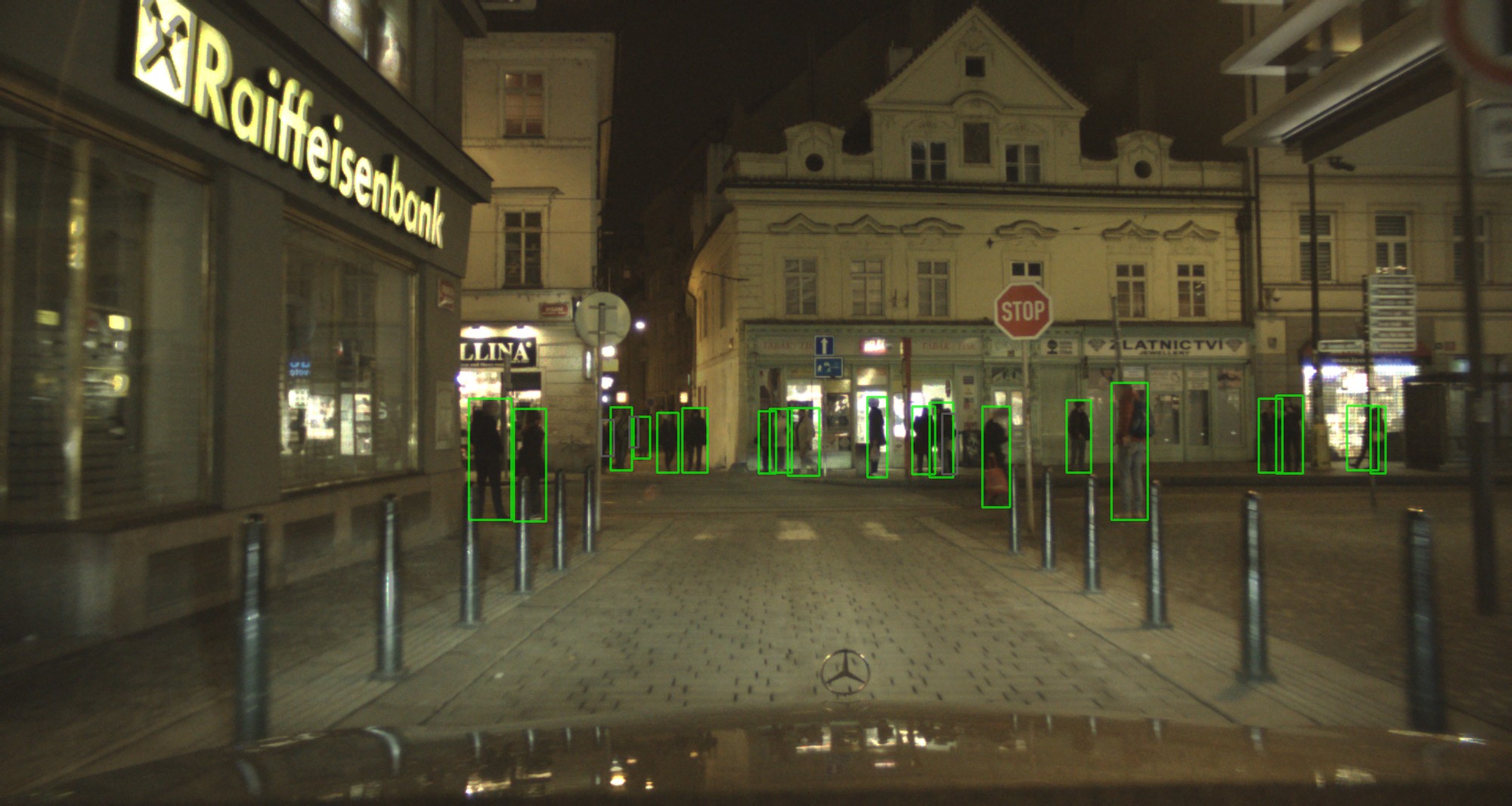
The EuroCityPersons dataset is a large-scale human detection benchmark of over 238,200 person instances manually labeled in over 47,300 images recorded throughout Europe. It contains highly diverse, accurate and detailed annotations of pedestrians, cyclists and other riders in urban traffic scenes. The images for this dataset were collected on-board a moving vehicle in 31 cities of 12 European countries. The dataset also contains over 211,200 person orientation annotations.
Recordings were made with a state-of-the-art automotive-grade two megapixel camera (1920 x 1024) with rolling shutter at a frame rate of 20 Hz. The camera, mounted behind the windshield, originally yielded 16 bit color images; this high dynamic-range was important for capturing scenes with strong illumination variation (e.g. night-time, low-standing sun shining directly into the camera). Images were debayered and rectified afterwards.
For the purpose of EuroCity Persons benchmark, and for allowing comparisons with existing datasets, the original 16-bit color images were converted to 8-bit by means of a logarithmic compression curve with a parameter setting different for day and night.
The authors collected 53 hours of image data in total, for an average of 1.7 hours per city. To limit selection bias, they extracted every 80-th frame for their detection benchmark without further filtering. This means that a substantial fraction of the person annotations in the dataset are unique, although especially at traffic lights and in slow moving traffic, same persons might appear in different annotations. Even so, due to sparse sampling at every four seconds, image resolutions and body poses will differ.
They annotated pedestrians and riders; the latter were further distinguished by their ride-vehicle type: bicycle, buggy, motorbike, scooter, tricycle, wheelchair. All objects were annotated with tight bounding boxes of the complete extent of the entity. If an object is partly occluded, its full extent was estimated (this is useful for later processing steps such as tracking) and the level of occlusion was annotated. They discriminated between no occlusion, low occlusion (10%-40%), moderate occlusion (40%-80%), and strong occlusion (larger than 80%). Similar annotations were performed with respect to the level of object truncation at the image border (here, full object extent was not estimated). For riders, they labeled the riding person and its ride-vehicle with two separate bounding boxes, and annotated the ride-vehicle type. Riderless-vehicles of the same type in close proximity were captured by one class-specific group box (e.g. several bicycles on a rack).
They define various data subsets on the EuroCity Persons dataset: 1. A day-time and a night-time data subset, each with its own separate training, validation and test set. 2. Reasonable: Persons with a bounding box height greater than 40 px which are occluded/truncated less than 40%. 3. Small: Persons with a height between 30 px and 60 px which are occluded/truncated less than 40%. 4. Occluded: Persons with a bounding box height greater than 40 px which are occluded between 40% and 80%.
These data subsets can be used to selectively evaluate properties of person detection methods for various sizes or degrees of occlusion.
            @article{braun2019eurocity,
  author = {Braun, Markus and Krebs, Sebastian and Flohr, Fabian B. and Gavrila, Dariu M.},
  doi = {10.1109/TPAMI.2019.2897684},
  journal = {IEEE Transactions on Pattern Analysis and Machine Intelligence},
  title = {EuroCity Persons: A Novel Benchmark for Person Detection in Traffic Scenes},
  year = {2019}
}